
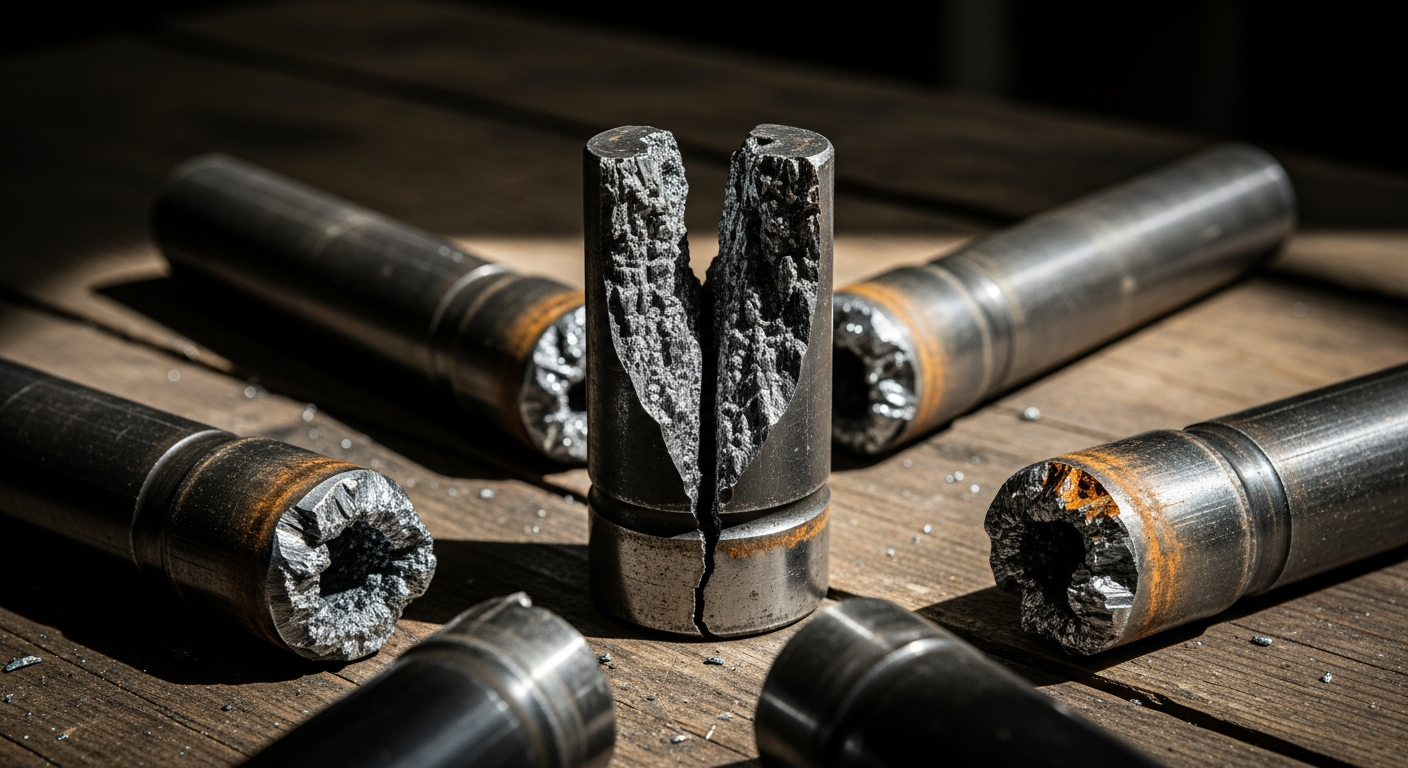
Rod failures look random in the moment. Looking at the patterns across dozens of strings over years, they concentrate in five categories. Each has a known fix. Teams that apply the prevention program see failure rates drop by half or more. Teams that do not keep pulling rods and blaming the rods.
The Five Root Causes
Fatigue from cyclic loading. Every stroke loads and unloads the rod. Millions of cycles. Fatigue failures originate at stress concentrations - pin shoulders, thread roots, mechanical damage from tongs or handling. Prevention is in material selection (grade appropriate to service), load management (don't over-stress by over-pumping), and handling discipline.
Corrosion-fatigue. Cyclic loading plus corrosive environment accelerates crack growth. H2S, CO2, chloride waters, oxygen ingress - each one amplifies fatigue damage. Prevention requires an inhibitor program matched to water chemistry and consistent injection, not the occasional batch treatment.
Buckling-induced side loading. In deviated wells or under fluid pound, rods buckle helically, press against tubing, wear, and eventually fail at contact points. Sinker bars, guides, and pump-off control reduce the buckling. Matching rod string design to actual wellbore geometry (high-res surveys, short step lengths) places guides where they matter.
Connection failures. Thread damage, bad make-up torque, wrong compound. These are preparation failures - preventable by disciplined procedure and calibrated tools per API RP 11BR.
Mechanical damage. Handling during installation or pull. Fishing operations. Careless rig-up. These show up as nicks, bends, or localized stress concentrations that become crack initiation sites later.
The Prevention Program
Inhibitor injection matched to measured water chemistry, continuous rather than batch where economics allow. Pump-off control to eliminate fluid pound. Sinker bars and guides placed per simulation on full-resolution survey data. API RP 11BR make-up discipline with calibrated torque tools. Rod handling procedures documented and followed - no dropped rods, no damaged couplings accepted as installed.
What Field Data Tells You
Track failures by location on the string, joint number, rod grade, make-up record, and fluid chemistry. Patterns emerge across a fleet that are invisible on any single well. Most operators discover their failure rate clusters around two or three specific causes once they have six months of data - and fixing those two or three changes the economics of the whole field.
Bottom Line
Rod failures are not random. They trace back to the same handful of causes on most fields. Fatigue, corrosion-fatigue, buckling, connection failures, mechanical damage. A disciplined prevention program covering all five - with inhibitor chemistry matched to measurements, pump-off control, proper string design, API RP 11BR make-up, and documented handling - cuts failure rates in half on most operations. The rods are usually fine. It is everything around them that needs the work.