
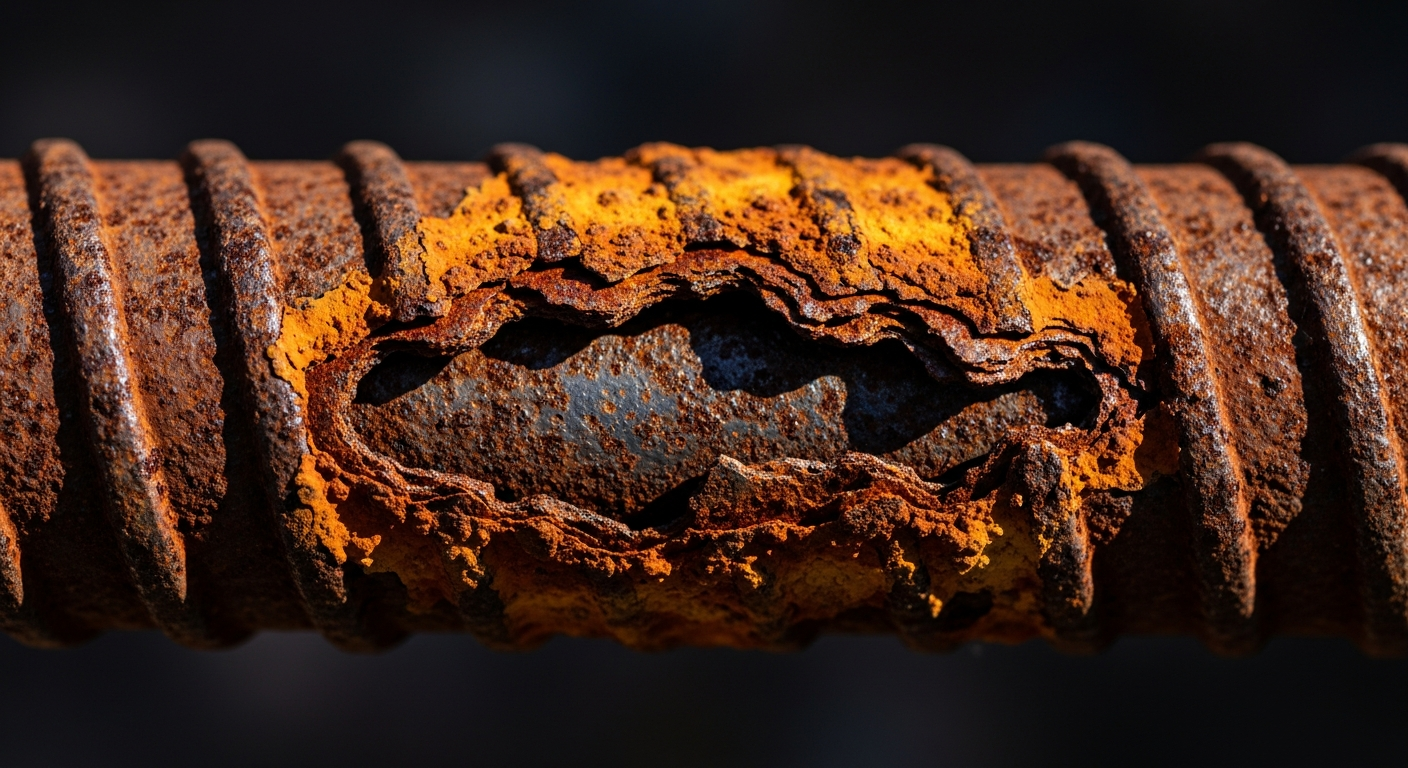
Corrosion by itself damages rods and tubing slowly. Combined with cyclic loading - as it is in every rod-pumped well - it becomes corrosion-fatigue, which accelerates failures dramatically. High water cut, H2S, CO2, and chloride waters each contribute. The treatments work, but most operators run them too sparingly or too inconsistently to actually control the damage.
What Corrosion Actually Does
Pitting: localized attack creates stress concentrations. Each pit is a crack initiation site under cyclic loading. A rod that would last 10 years in dry service can fail in 2 in a pitted corrosive environment.
Wall thinning: uniform attack reduces cross section. Tubing that was 0.25 inches becomes 0.18 inches over a few years, loses pressure rating, eventually holes through.
Hydrogen embrittlement (H2S service): sour gas produces atomic hydrogen that enters the steel and reduces toughness. Sudden brittle failures that look like impacts were actually slow hydrogen damage.
The Common Chemistries
CO2 (sweet corrosion): forms carbonic acid, produces uniform thinning and some pitting. pH-dependent. Manageable with film-forming inhibitors. H2S (sour corrosion): iron sulfide scales, hydrogen embrittlement concerns, requires NACE MR0175 materials and specific inhibitor chemistry. Chloride waters: accelerates pitting, stress corrosion cracking in susceptible alloys. Oxygen: usually an indicator of air ingress from handling or surface equipment leaks, dramatically accelerates all other corrosion processes.
What an Inhibitor Program Looks Like
Continuous injection beats batch treatment when the exposure is continuous. A film-forming inhibitor at the correct concentration maintains protection; batch treatments protect for hours to days, then the film is depleted and the string runs bare until the next treatment. Economics usually favor continuous on any well with meaningful water production.
Chemical selection matches the water. A generic inhibitor does not work against every mix. Run a water analysis, select chemistry accordingly. Monitor results with corrosion coupons or probes - not just laboratory reports.
Measuring Effectiveness
Corrosion coupons in the production tubing give you measurable mils-per-year data. Ultrasonic wall thickness measurements on production tubing tell you uniform thinning rates. Failure data (rod break locations, tubing holes) tells you whether the program is working in the most important sense - are things still breaking or not.
An inhibitor program that looks good on paper but does not reduce failures is failing. Adjust. The measurement feedback loop is what makes these programs work.
Bottom Line
Corrosion in rod-pumped wells is manageable with disciplined inhibitor chemistry matched to water analysis, continuous injection when economics support it, and measurement to confirm the program actually works. Corrosion-fatigue is the real failure mode - treat aggressively because the alternative is rod strings that fail at a fraction of their rated life.