
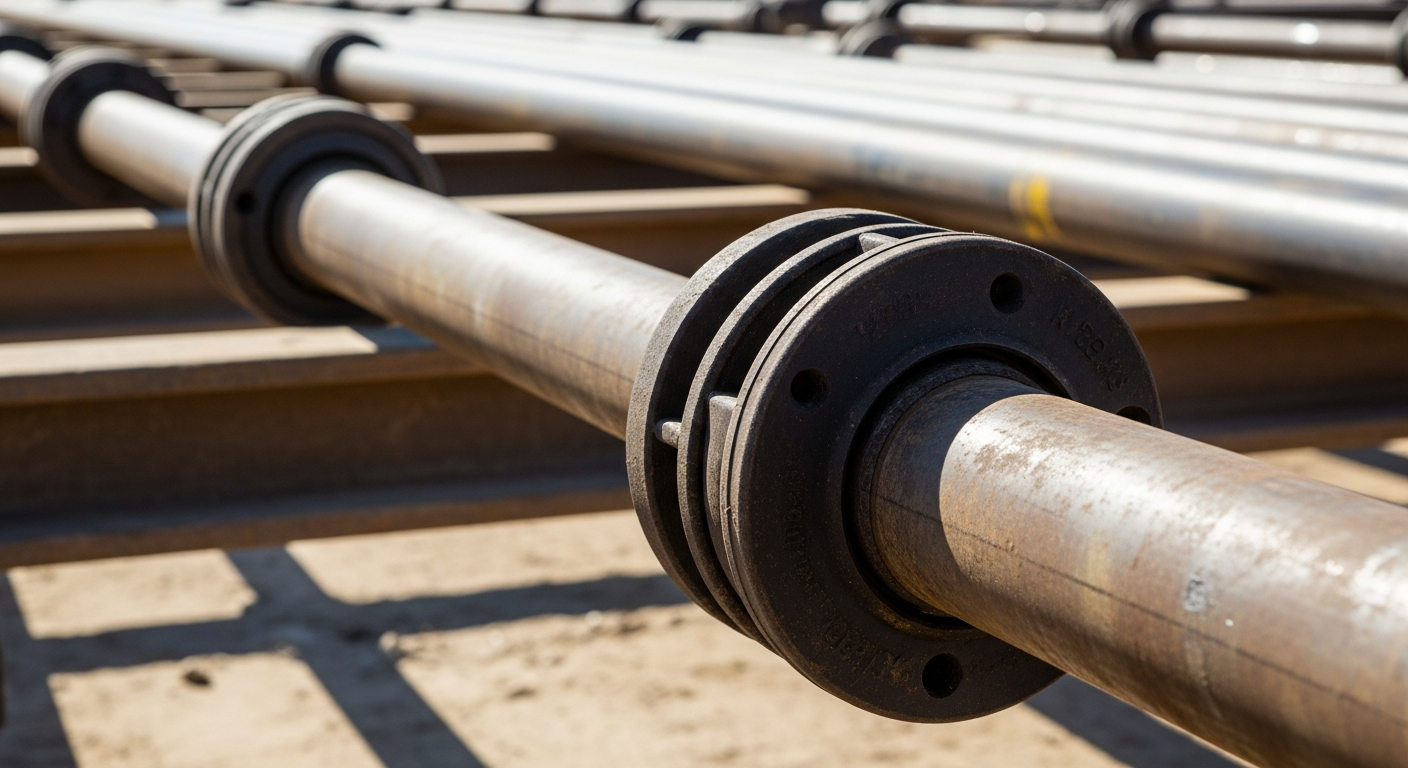
Rod guides keep rods away from tubing at curvature points. Placed correctly, they prevent rod-on-tubing wear, reduce friction, and extend run life. Placed everywhere, they add cost and unnecessary friction. The goal is to identify which rods actually need guides - and where on the rod to install them.
Where Guides Are Needed
Every position where the simulated rod string contacts the tubing under expected operating loads. Contact happens at curvature points - doglegs, build sections, horizontal-lateral transitions. Side load at a contact point is proportional to dogleg severity times axial tension. Higher DLS and higher tension mean higher side load and faster wear.
The question becomes: at which measured depths does the simulation predict rod-tubing contact, and of those contacts, which ones have side load high enough to cause wear in the planned service interval?
Why High-Resolution Surveys Matter Here
Coarse survey data smooths over micro doglegs. The smoothed trajectory predicts no contact at positions where the actual wellbore curvature creates contact. Guides get placed based on the smoothed trajectory and miss the real wear zones. Rod strings fail at positions the simulation said were fine.
Short step length plus high-resolution survey (10-foot steps with 10-foot gyro data) puts guides where the wellbore actually bends, not where the smoothed approximation suggested. This is the primary reason to invest in better survey data - guide placement accuracy.
Guide Types
Molded plastic guides (polyethylene, nylon) are the standard. Low cost, reasonable wear resistance, easy to install. Right for most applications.
Metallic guides (bronze, steel) for high-temperature or severe abrasive service. More expensive, handle more demanding conditions.
Rotating guides: spin in service, distributing wear around the rod circumference instead of concentrating it on one side. Valuable in long-stroke applications or where one-sided wear has been a problem.
Spacing and Quantity
Put a guide at each predicted contact point. Add guides above and below to spread load. Don't guide rods with zero predicted contact - they do not need them and the friction penalty is real.
A typical deviated rod string might have 20 to 100 guides on a 5,000 foot string. The specific number depends on trajectory complexity and the simulation's predicted contact distribution.
Bottom Line
Guide the rods that need guiding. Location comes from the simulation, which in turn depends on high-resolution survey data and a step length that matches it. Blanket guiding adds cost. Under-guiding produces failures. Targeted guiding matches the physical reality of where the string contacts the tubing and treats only those positions.