
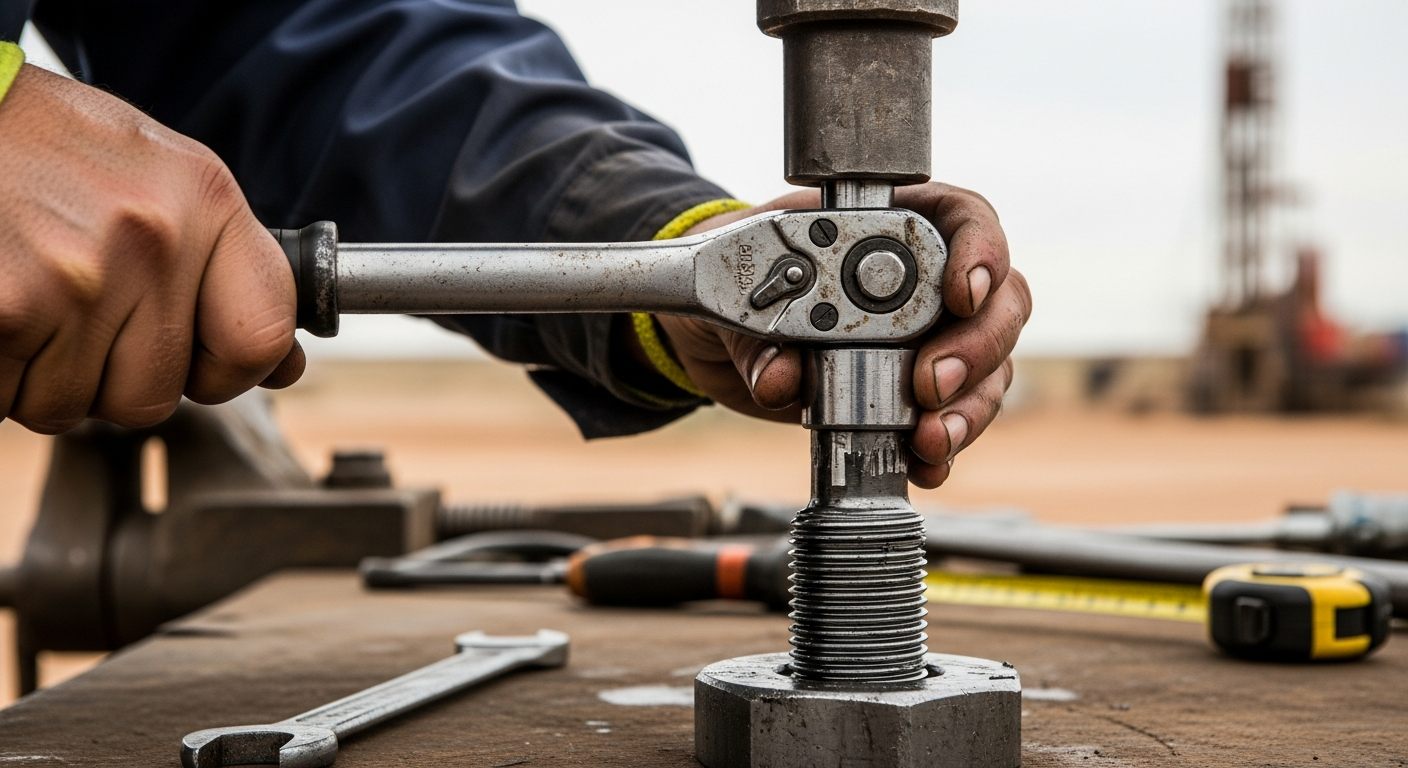
Rod connections are the highest-stress points in the string. They transmit millions of cyclic load cycles and they have to hold a tight seal and a strong preload against every one of them. Most rod failures that show up as pin breaks, coupling splits, or thread galling are not material failures. They are make-up failures - the connection was never torqued correctly in the first place.
Too little torque and the connection loosens further under cyclic loading. Too much and you crack pins or overstress threads, especially on high-strength Class D or higher grades. API RP 11BR documents the procedure that prevents both and it is not optional - it is the difference between a rod string that runs for years and one that returns to surface in pieces.
What Preload Actually Does
Correct torque stretches the pin and compresses the coupling. That stretch creates a high initial preload that keeps the shoulder faces in firm contact through every cycle. As long as the preload exceeds the cyclic load, the shoulders never separate. Fatigue cracks do not propagate at the thread roots. Connection fatigue is really a preload problem.
Under-torqued: shoulder separation during the stroke, hammering, thread wear, eventual back-off or parting. Over-torqued: pin fractures during make-up on high-strength rods, galling, coupling splits. Dirty threads or wrong lubricant: inaccurate torque readings, wrong preload, both failure modes possible. The common thread through all of it is that the connection was assembled wrong.
Preparation Before Any Torque Is Applied
Clean threads and shoulders on both pins and couplings with a non-metallic brush and approved solvent. Remove every trace of old thread compound, dirt, rust, storage grease. Dry completely. Do not use diesel - it leaves a film that changes the friction coefficient and throws off your torque reading.
Inspect for damage. Reject rods or couplings with damaged threads, nicks, galling, deformed shoulders. One damaged pin in a string is a failure waiting to happen. Apply the correct thread compound sparingly and uniformly. The compound matters - different compounds have different friction coefficients and the published torque values assume a specific one.
The Make-Up Procedure
Use the correct torque for the rod grade and size. API RP 11BR publishes the values. Use calibrated tools - a power tong with a working torque gauge, not a pipe wrench and estimate. Verify calibration regularly. Make up in one smooth motion to shoulder contact, then apply the specified torque without hesitation. Stop-and-restart torqueing produces inconsistent preload.
Record every connection. Joint number, torque achieved, compound batch, tool ID. When a failure comes back to surface, you want the record. Patterns emerge in the data that are invisible joint by joint.
Displacement and What It Means
Displacement is the axial compression of the coupling and extension of the pin at final torque. A correctly made-up connection has a predictable displacement value. If a connection hits the right torque but does not achieve the expected displacement, the connection is not holding the preload you think it is. Displacement checking is cheap insurance and API RP 11BR specifies it for a reason.
Bottom Line
Most rod string failures are connection failures. Most connection failures are make-up failures. Clean the threads, use the right compound, torque with calibrated tools to the API RP 11BR spec, verify displacement, and keep records. This is not exotic engineering - it is disciplined field procedure. Teams that follow it see connection-driven failures drop by half or more.